Learning Blog
Composition of Hair and Stages of Growth

Written by Lizzie Learn
On 19th May 2021
It can be helpful for you to understand the overall composition of hair and the various stages that it goes thorough during its life cycle. Understanding hair gives you an idea of why it is so resilient and tough to get rid of. It will also help you identify and be able to explain to your clients the reasons why various removal methods do not work.
When you are dealing with hair, it is very important to make sure that you have an understanding of it so that you can effectively explain it to your clients if they ask questions and use the information to ensure that you are handling it effectively.
Hair's Composition
The hair has two parts including the shaft and the follicle. The follicle is a structure in the skin that is shaped like a club. There are blood vessels in a network at the end of the follicle. It feeds the hair nutrients to assist in the growth. This is called the papilla. There is a bulb surrounding the papilla. The sebaceous gland secretes oil to help condition the hair. An erector muscle causes the strand to stand up and keeps it attached to the bulb. The follicle has nerve cells wrapping around it and these nerve cells send the message to the erector muscle to get it to stand up.
The shaft of the hair is made of keratin, a protein that the skin produces. It makes the hair flexible and strong. The keratin is made up of a spiral chain of amino acids. Proteins are macromolecules or large biomolecules that are made up of one or more amino acid residues in a long chain. They perform many functions in the body. Keratin is a structural protein that works to protect the epithelial cells from stress and damage that can kill the cell. It is present in human skin and also hair. The proteins are connected by a bond that is strong and that makes the hair strong. It consists of three layers, the inner medulla, the cortex, and the outer cuticle. The hair has cuticle scales. They are narrow and flat called imbricate.
Humans are mammals and they all have hair to help them keep their body temperature under control, protect the insides from the sunlight, and they act as an organ for sensing. The temperature regulation function works with the hair and the muscles in the skin. If it is cold, the hair strands are held upright and they create pockets to trap the air in. That is why the hair stands up when you are cold. It is trying to create an additional layer of warm air to increase insulation. If it is warm outside, the muscles become relaxed and flattened against the body to release the hair that may be trapped. Hair regulation in humans plays less of a role in the insulation and that is why we have to wear clothing.
The Cuticle
The transparent outer layer of the shaft of hair is called the cuticle. It consists of scales that overlap each other and help to protect the layers inside. They start at the proximal end, which is the one that is close to the scalp. The scales are like shingles that can be around five or twelve in depth. The scales are formed by dead cells and it creates a strong shaft. It forms a barrier of protection for the shaft. It also gives the hair its mechanical strength. When the hair is healthy, the cuticle will regulate the water content and that makes the hair shiny when it is healthy. The cuticle gets damaged by heat, chemical processing, brushing, exposure to the sun, and wind exposure.
The Cortex
This is the largest part of the shaft of hair. It is the part that contains the granules of pigment called melanin. This melanin determines the colour of the hair. How this pigment is distributed varies between various individuals.
The Medulla
The medulla can be filled with cells or hollow. Some people have a fragmented medulla and others have no medulla. Some have a continuous structure and others have it doubled. It can be pigmented or lacking pigment. The medulla can also be called the marrow or pith of the hair. It is made up of round cells. The medulla is normally found in thick or coarse hair and absent in thin or blond hair. Some hair does not have a medulla section.
Various Hair Types
Hair can be different in length, diameter, texture, color, and shape. The texture can be fine or course. Hair on different parts of the body are different as well. For example there are six types of hairs that can vary: head hair, eyelashes and brows, mustache and beard, underarm, body hair, and pubic hair. They each have their own shape and characteristics. Therefore, you may not be able to treat all hair the same. By understanding the differences, you can use that information to make sure that you choose the right wax for handling that hair.
Hair's Life Cycle
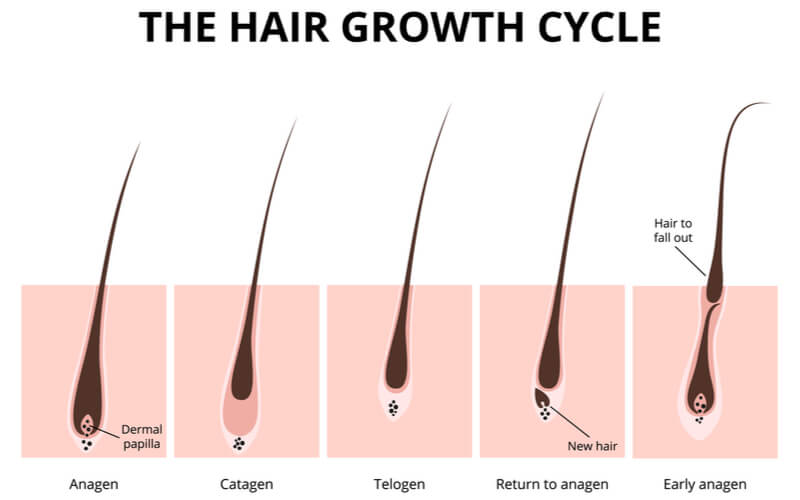
The hair goes through three stages in its growth cycle. The anagen stage is the first stage and lasts around one thousand days. The hair is in this cycle for around eighty to ninety percent of the time. It is the active growth period and the cells surrounding the follicle divide rapidly and deposit materials into the hair. The second stage is the catagen stage where it changes as it grows. It accounts for only two percent of the development and growth. The last stage is called the telogen stage. This is when the follicle of the hair is resting and dormant. The hairs are lost easily in this stage. Around ten to twenty percent of the hairs are in the stage of development. The average rate of hair growth is around 1.3 cm every month.
Various Hair Treatments
Hair is treated in different ways. Bleached hair has the granules of pigment removed. This causes the hair to be yellow color and makes it harder to be seen against the skin. This is why many people get the hair above their top lip bleached. The hair is hard to see and therefore, it looks like it isn't there. Dyed hair is a change to the shaft color. The hair beneath the skin will still remain the original color. That is why as the hair grows out, the root is the natural hair color again.
What does it mean for you?
First of all, it is a good idea to understand that the hairs on various parts of the body are different. You may find that you will need to use different types of waxes to get the most hair removed. There are definitely waxes designed for the face. These waxes are not as strong as the other waxes. This has to do with the sensitivity of the skin on the face and not so much about the hair. This should not be compromised.
However, some waxes work better for thicker and thinner hair that is found on the body. There are waxes that work best with curly or straight hair as well. When you are choosing a wax to try, apply it to more than one section of the body before you throw it away and mark it a loss. You may find that it works better on different areas of the body.
It is also a good idea to understand the difference of hair for people of different races. It may be a helpful tool because there are distinct differences. This is mostly on a smaller level and may not ever change how you conduct your procedures. However, you may find various waxes work on people of different races differently.
The most important factor regarding hair that you need to consider is likely the hair growth cycle. It explains why your clients have to continue to come back. Knowing about how long it takes for the hair to grow back is perfect for scheduling purposes. Plus, knowing that not every hair is in the same stage at the same time can also be very helpful for explaining why when you pluck your client's brow, some hairs are still present soon after.
Utilising your Knowledge about Hair
A client comes back in because they got their eyebrows waxed a few days prior and they are already experiencing some hair growth. They can be frustrated thinking that you obviously didn't pull the hair from the root if it is already growing back.
Knowing that the hair grows in different stages allows you to explain to them why they may need to pluck some hairs along the way to maintain their brow. Offer to pluck the stray hairs and explain to them that the wax could only hold onto the hairs that were between a quarter of an inch and a half of an inch. The hairs that were shorter than that may not have been captured by the wax and therefore were not pulled from the root. You can also state that the hair that was present and growing below the surface were not pulled from the roots either. These hairs may have started to poke through the surface of the skin and are now showing.
By knowing about hair and its cycle, you can explain to your clients, while you are rectifying the situation this time around, so that you don't lose customers because they think that you have done a bad job. It will give you the information that you need to effectively communicate with your client and handle their concerns. They may want to know why they get bumps after they shave. You can explain to them that they are from ingrown hairs and give them ways to prevent it. For example, waxing can sometimes decrease bumps on the skin and therefore, you are giving them smoother skin and also dredging up some business in the process.
Be proactive. Educate your clients when there is a lull in the conversation. Let them know that they may need to pluck a few hairs as they appear. That way they can maintain their look longer. If they are committed to maintaining their look until it starts to get out of hand, you do lose those extra visits, however the value that you are presenting to the client is much more valuable. You are their expert and they expect you to have the answers to their questions. The more you know, the stronger your business will be and the more services that you will be able to provide your customers. They want a one stop shop instead of having to go to many different places and schedule multiple appointments.
Another important reason why it is important to understand hair is because of the damage that can happen to the hair by using various chemicals and treatments. If the tools are used improperly, it can cause the hair to become damaged. For example, if you don't wax the client properly, it can damage the cuticle. This can cause the hair shaft to grow through the skin instead of through the pore. Improper procedures can cause painful bumps called ingrown hairs. This is something that will quickly ruin your waxing career. Understanding the proper technique is important because it can prevent irritation and ingrown hairs.
When you understand the composition of the hair, you will be more equipped to combat it. You will be able to choose the right procedure and understand why it is so important to follow the procedures properly. If you put your focus on treating the hair in accordance with the information in this section, it will help you perform them correctly. You will see how it is easier to keep the entire hair shaft intact by pulling the hair in the opposite of the hair growth. If you don't do the procedure properly, the hair can be damaged and not pulled from the root. That will cause the hair to grow back in incorrectly or show through the skin faster making it effective for less. When the hair is broken, it may not be pulled from the root. Therefore, it will take less time to continue growing past the surface of the skin and into the root if it grows out instead of into the skin.
Learn with confidence...



 RRP
$100
RRP
$100
Get a FREE Course
Tick this box to Sign up for our newsletter, and get access to the Interview Skills and CV Writing Certificate course for free! By signing up, you agree to our Privacy Notice & Cookie Policy and to receive marketing and related emails from academy+ brands. You can unsubscribe at any time.What our students say about us...

Lovely course for people who want to know the basics and of sign language. It's has helped me to get more of an understanding and will greatly benefit me in my workplace. So easy to pick up and the videos were easy to understand. Would definitely recommend to anyone.
Chloe Hambly

This is a great course for any level of knowledge. Very easy to navigate, great practical tasks and explanations are very clear. You can revise any module with no problem. The test wasn’t too hard if you completed every module. It may be handy to make some notes before you start. Overall I'm very happy with my choice. Thank you New skills for my New skills :)
Julia Bobkova

I found this course incredibly useful, as it provided me with practical knowledge which I can implement in my role as a Support Worker. The videos were clear and concise, and the downloadable worksheets reinforced what I had learned as I was able to put pen to paper. Overall, a fantastic course for a great price! I am looking forward to taking on my next one.
Teleisha Harley

I took up this course initially to help me with my own dog, but found that as I worked through the material I actually started thinking that this could be something that I could use to make a second income. From start to finish I found the course engaging and interesting. I am now doing another dog related course and am experiencing the same level of enjoyment. I would recommend New Skills Academy without hesitation.
Keith Smith

I am a doctor. This course is well organized, covering all areas of CBT. The videos and practical tips are very helpful. All the modules are arranged with good explanations and examples. Also each module consists of quick test and assignment which enables you to gain knowledge. Finally I would like to thank the New Skills Academy team.
Dr. M. Arshad

Wow what an incredible insight for the start of anyone's journey in property. This course gives you so much information and there are tests and questions on each of the modules. The course is very easy to follow and well laid out. You can actually make notes on the pages of each module using the notes tab! I am very excited to say that I passed and I only spent one week on this course. I will print all the PDF information and keep it in a file with my certificate. I feel very confident for my future plans now I have completed this course.
Nichola Anderson

This course is a great way to brush up on my rusty excel skills, I recommend this course to anyone looking for something to do during lockdown, it's easy to use and talks you through each stage step by step. It has given me the confidence I need to further my career.
Georgia Darke

Very interesting and helpful course. I ve learned a lot of interesting things about make up and the tutorials were very helpful and easy to understand. I really reccomend this course for everyone who is passionate about make up and wish to develop their skills and make a career from their hobby.
Nicoleta Lucaci