Veterinary Support Assistant Diploma


Why you should study with us

Veterinary Support Assistant Diploma Course
This course will give you an overview of the veterinary industry, the role played by Veterinary Support Assistants (VSAs), and the most common issues and challenges faced by those working in the profession.
It will equip you with the knowledge you will need to communicate effectively with other members of the veterinary team and further your career in this sector. Working as a VSA is a great way of making a real difference to the lives of sick and injured animals on a daily basis. However, the terminology and technical knowledge required to succeed as a VSA can seem intimidating to industry newcomers.
This course presents key concepts in animal care in a straightforward manner, so that you can begin your career with confidence. You will also obtain a working knowledge of key legislation necessary to keep you and your patients safe.
From administering first aid to routine surgery, you will learn what happens in the consultation rooms and operating theatres in a typical veterinary practice. The course addresses patient care at every stage of treatment, from diagnosis to surgery and post-operation recovery. It focuses primarily on the treatment of common domestic species, but the needs of exotic animals and horses are also addressed.
In light of the increasing emphasis on customer service within the industry, the course also examines the typical customer’s experience as they seek out the best possible care for their pet. Owners can become highly stressed when their beloved pet is ill, and this course contains practical advice for communicating effectively with customers facing emotional strain both in person and on the telephone.
This course will provide anyone looking to work as a VSA with a realistic insight into the workings of a veterinary practice and future options for career progression. It will also be of interest to anyone who wishes to learn more about animal care or further their knowledge of the veterinary industry in general.
What you will learn:
- An introduction to veterinary medicine and job roles available within the industry
- How to improve your chances of getting a job as a VSA and how to undertake further training once you have obtained a position
- Health and safety issues that affect VSAs including the pieces of legislation addressing animal welfare and workplace safety
- How veterinary patients are cared for and monitored by veterinary staff during their stay
- An overview of animal welfare issues, including common ethical dilemmas and frameworks for making difficult decisions
- Common terminology and equipment used by veterinary staff in consultations and during surgery
- The most common procedures, including diagnostic tests, used in veterinary medicine
- How to handle a variety of animal species, including cats, dogs, horses and small mammals
- How emergency situations are handled, from initial assessment through to the administration of first aid and treatment
- The role of customer service in a modern veterinary surgery and how a practice can establish a positive role within the wider community
Benefits of taking this course:
- You can learn the material any place, any time, and at your own speed.
- All you need is an internet-enabled device.
- Content is presented as brief modules, making learning easy. Access to an online support system.
- A complete overview of the issues faced by those working as VSAs in modern veterinary practices.
- Affordable cost.
This course includes
24/7 Student Support
End of course certification
Lifetime access to your course
- The key purposes and functions of a veterinary practice
- A brief history of veterinary medicine
- Why it is important to understand the role of each member of a veterinary team
- An overview of the most common roles within a practice, including the necessary qualifications and main responsibilities
- The entry requirements for entering into the veterinary profession as a veterinary support assistant (VSA)
- Why it is beneficial to pursue a formal qualification
- The most popular qualifications open to VSAs
- The main areas covered by VSA qualifications
- Why you need to be aware of health and safety laws and legislation from the outset of your career in the veterinary industry
- The purposes of health and safety legislation
- The nature and purpose of the Veterinary Surgeons Act 1966
- The nature and purpose of the Health and Safety at Work Act 1974
- Why a VSA should be familiar with the techniques used to monitor inpatients
- The assessment process for newly admitted patients
- How veterinary staff ensure that inpatients are given the opportunity to have their usual day to day needs met
- The most commonly monitored measures of health, such as temperature and blood pressure
- What is meant by animal welfare and why it is important to consider the practical and philosophical issues raised by the topic
- The nature and purpose of the Five Freedoms model approach to animal welfare
- The meaning of the term “stakeholders” in relation to animal health and welfare
- The role of ethics in maintaining animal health and welfare
- Why VSAs need to be familiar with common terminology and equipment
- Common prefixes used by veterinary professionals
- Common suffixes used by veterinary professionals
- The equipment most commonly used in a consultation room
- The purpose of anaesthesia and the ways in which it is administered
- The most common surgical procedures carried out by veterinary surgeons
- Diagnostic tests used in veterinary practice to identify health problems in patients
- The day to day practices that comprise nursing care and how they are carried out
- Why animal handling is a key skill for vets, RVNs and VSAs
- Essential points to bear in mind when handling dogs
- Essential points to bear in mind when handling cats
- How to handle small mammals, including hamsters and rabbits
- Why VSAs should be familiar with common emergencies arising in everyday veterinary practice
- The purposes and nature of first aid and who is responsible for its administration
- The importance of triage and initial assessment, in ensuring the best possible outcome for a patient
- An overview of emergency procedures, including Cardiopulmonary Resuscitation (CPR), blood transfusions and the Heimlich Manoeuvre
- Why customer service is an important skill for everyone working in a veterinary practice
- How the typical customer selects a veterinary practice
- How understanding the customer’s journey can help you deliver great customer service
- How to interact positively with customers on the telephone
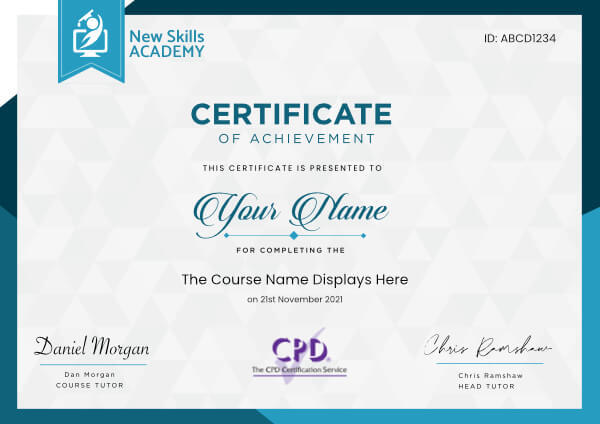
 ID: YDFT67YHJ
of achievement
This certificate is presented to
Your Name

For completing the
Veterinary Support Assistant Diploma
on 21st November 2026
Selena Hurford
Selena Hurford
Course Tutor

Daniel Morgan
Daniel Morgan
Head of Academy
Anyone who has an interest in learning more about this subject matter is encouraged to take the course. There are no entry requirements to take the course.
The course is broken down into 10 individual modules. Each module takes between 20 and 90 minutes on average to study. Although you are free to spend as much or as little time as you feel necessary on each module, simply log in and out of the course at your convenience.
You can study the course any time you like. Simply log in and out of the web based course as often as you require. The course is compatible with all computers, tablet devices and smart phones so you can even study while on the move!
Once you have completed all 10 modules there is a multiple choice test. The questions will be on a range of topics found within the 10 modules. The test, like the course, is online and can be taken a time and location of your choosing.
The pass mark for the test is 70%.
If you don’t pass the test first time you will get further opportunities to take the test again after extra study. There are no limits to the number of times you can take the test. All test retakes are included within the price of the course.
You can either use your Visa, MasterCard, American Express, Solo cards or PayPal account to pay for the online course. Our site uses the latest SSL encryption to ensure your safety. All payments are handled securely by PayPal.
You can begin the course immediately after your payment has been received. You will create your login details during the checkout process. We will also send you an email confirming your login details.
We estimate that the course will take about 12 hours to complete in total, plus an additional 30 minutes for the end of course test.
Once you have been awarded your certificate it is valid for life. The certificate does not expire or need renewing.
I started the HR Management Diploma Level 2 – CPD Certified & IVCAS Accredited in November 2016, and I can say hand on heart it has been the best experience of my life.
Everything I have learnt here, every lesson, has been practical and useful, with real skills that are relevant to the real world, instead of hours of boring theory and history of the subject. Straight away we were learning real web design.
This course has been incredibly helpful and I have learnt far more than I could have ever imagined and I have only completed 4 of the 20 modules.

Chloe Gibson
I really enjoyed the course and would recommend this to my friends.
I completed a City and Guilds Certificate 40 years ago and was looking at bringing my skills up to date. This gave me the encouragement and insight to what I needed to go back into hairdressing. I understand the importance of keeping my skills up to date and would like to study further in styling, hair treatment and colouring.
Thank you very much I enjoyed the 27 modules attached to the course. I particularly enjoyed the videos attached to the course and have always enjoyed putting hair up for special occasions such as weddings.

Margaret Whitehead
I was bought this Nail course as a birthday present and it has really inspired me as I have always had a passion for Nail design.
This course was well structured, clear, and easy to follow. It ran smoothly and I knew exactly how long I was expected to work on each module.
I learnt all about the business side to the salon as well as physical skills and it was easy to do the exams and get my certificate. I would thoroughly recommend this course or similar ones to other people as it was so flexible and I can now take my new skills straight into the working world.

Lauren Dean
I have just complete the nail technician diploma award and delivered professional manicures and nail extensions to my friends and family who are very pleased with their treatments! The course was easy to follow and fun to do!

Fiona Baker
I started this course so I could learn about payroll as I am interested in hopefully securing future employment within this area.
The course is brilliant to use. The information available on the individual modules is so easy to read and understand. The activities at the end of the modules refresh what you have just learnt, you can print these also so you are able to make notes for your own personal reference to go back to. You can also log onto your course at home or if your out and about on your phone.
Overall I would recommend this course and I am so pleased I decided to go for this and will look forward to being able to write this onto my CV.

Laura Malcom
This course was super fun and so easy to follow.
I loved the convenience of learning everywhere, I could use my phone or tablet and do the course in the car, breaks while at work or in the privacy of my living room. The videos were wonderful and the worksheets helped so much as well... I'm more confident in myself now :)

Tara Ireland
Veterinary Support Assistant Diploma Course
This course will give you an overview of the veterinary industry, the role played by Veterinary Support Assistants (VSAs), and the most common issues and challenges faced by those working in the profession.
It will equip you with the knowledge you will need to communicate effectively with other members of the veterinary team and further your career in this sector. Working as a VSA is a great way of making a real difference to the lives of sick and injured animals on a daily basis. However, the terminology and technical knowledge required to succeed as a VSA can seem intimidating to industry newcomers.
This course presents key concepts in animal care in a straightforward manner, so that you can begin your career with confidence. You will also obtain a working knowledge of key legislation necessary to keep you and your patients safe.
From administering first aid to routine surgery, you will learn what happens in the consultation rooms and operating theatres in a typical veterinary practice. The course addresses patient care at every stage of treatment, from diagnosis to surgery and post-operation recovery. It focuses primarily on the treatment of common domestic species, but the needs of exotic animals and horses are also addressed.
In light of the increasing emphasis on customer service within the industry, the course also examines the typical customer’s experience as they seek out the best possible care for their pet. Owners can become highly stressed when their beloved pet is ill, and this course contains practical advice for communicating effectively with customers facing emotional strain both in person and on the telephone.
This course will provide anyone looking to work as a VSA with a realistic insight into the workings of a veterinary practice and future options for career progression. It will also be of interest to anyone who wishes to learn more about animal care or further their knowledge of the veterinary industry in general.
What you will learn:
- An introduction to veterinary medicine and job roles available within the industry
- How to improve your chances of getting a job as a VSA and how to undertake further training once you have obtained a position
- Health and safety issues that affect VSAs including the pieces of legislation addressing animal welfare and workplace safety
- How veterinary patients are cared for and monitored by veterinary staff during their stay
- An overview of animal welfare issues, including common ethical dilemmas and frameworks for making difficult decisions
- Common terminology and equipment used by veterinary staff in consultations and during surgery
- The most common procedures, including diagnostic tests, used in veterinary medicine
- How to handle a variety of animal species, including cats, dogs, horses and small mammals
- How emergency situations are handled, from initial assessment through to the administration of first aid and treatment
- The role of customer service in a modern veterinary surgery and how a practice can establish a positive role within the wider community
Benefits of taking this course:
- You can learn the material any place, any time, and at your own speed.
- All you need is an internet-enabled device.
- Content is presented as brief modules, making learning easy. Access to an online support system.
- A complete overview of the issues faced by those working as VSAs in modern veterinary practices.
- Affordable cost.
This course includes
24/7 Student Support
End of course certification
Lifetime access to your course
- The key purposes and functions of a veterinary practice
- A brief history of veterinary medicine
- Why it is important to understand the role of each member of a veterinary team
- An overview of the most common roles within a practice, including the necessary qualifications and main responsibilities
- The entry requirements for entering into the veterinary profession as a veterinary support assistant (VSA)
- Why it is beneficial to pursue a formal qualification
- The most popular qualifications open to VSAs
- The main areas covered by VSA qualifications
- Why you need to be aware of health and safety laws and legislation from the outset of your career in the veterinary industry
- The purposes of health and safety legislation
- The nature and purpose of the Veterinary Surgeons Act 1966
- The nature and purpose of the Health and Safety at Work Act 1974
- Why a VSA should be familiar with the techniques used to monitor inpatients
- The assessment process for newly admitted patients
- How veterinary staff ensure that inpatients are given the opportunity to have their usual day to day needs met
- The most commonly monitored measures of health, such as temperature and blood pressure
- What is meant by animal welfare and why it is important to consider the practical and philosophical issues raised by the topic
- The nature and purpose of the Five Freedoms model approach to animal welfare
- The meaning of the term “stakeholders” in relation to animal health and welfare
- The role of ethics in maintaining animal health and welfare
- Why VSAs need to be familiar with common terminology and equipment
- Common prefixes used by veterinary professionals
- Common suffixes used by veterinary professionals
- The equipment most commonly used in a consultation room
- The purpose of anaesthesia and the ways in which it is administered
- The most common surgical procedures carried out by veterinary surgeons
- Diagnostic tests used in veterinary practice to identify health problems in patients
- The day to day practices that comprise nursing care and how they are carried out
- Why animal handling is a key skill for vets, RVNs and VSAs
- Essential points to bear in mind when handling dogs
- Essential points to bear in mind when handling cats
- How to handle small mammals, including hamsters and rabbits
- Why VSAs should be familiar with common emergencies arising in everyday veterinary practice
- The purposes and nature of first aid and who is responsible for its administration
- The importance of triage and initial assessment, in ensuring the best possible outcome for a patient
- An overview of emergency procedures, including Cardiopulmonary Resuscitation (CPR), blood transfusions and the Heimlich Manoeuvre
- Why customer service is an important skill for everyone working in a veterinary practice
- How the typical customer selects a veterinary practice
- How understanding the customer’s journey can help you deliver great customer service
- How to interact positively with customers on the telephone
ID: YDFT67YHJ
of achievement
This certificate is presented to
Your Name
For completing the
Veterinary Support Assistant Diploma
on 21st November 2026
Selena Hurford
Selena Hurford
Course Tutor
Daniel Morgan
Daniel Morgan
Head of Academy
Anyone who has an interest in learning more about this subject matter is encouraged to take the course. There are no entry requirements to take the course.
The course is broken down into 10 individual modules. Each module takes between 20 and 90 minutes on average to study. Although you are free to spend as much or as little time as you feel necessary on each module, simply log in and out of the course at your convenience.
You can study the course any time you like. Simply log in and out of the web based course as often as you require. The course is compatible with all computers, tablet devices and smart phones so you can even study while on the move!
Once you have completed all 10 modules there is a multiple choice test. The questions will be on a range of topics found within the 10 modules. The test, like the course, is online and can be taken a time and location of your choosing.
The pass mark for the test is 70%.
If you don’t pass the test first time you will get further opportunities to take the test again after extra study. There are no limits to the number of times you can take the test. All test retakes are included within the price of the course.
You can either use your Visa, MasterCard, American Express, Solo cards or PayPal account to pay for the online course. Our site uses the latest SSL encryption to ensure your safety. All payments are handled securely by PayPal.
You can begin the course immediately after your payment has been received. You will create your login details during the checkout process. We will also send you an email confirming your login details.
We estimate that the course will take about 12 hours to complete in total, plus an additional 30 minutes for the end of course test.
Once you have been awarded your certificate it is valid for life. The certificate does not expire or need renewing.
I started the HR Management Diploma Level 2 – CPD Certified & IVCAS Accredited in November 2016, and I can say hand on heart it has been the best experience of my life.
Everything I have learnt here, every lesson, has been practical and useful, with real skills that are relevant to the real world, instead of hours of boring theory and history of the subject. Straight away we were learning real web design.
This course has been incredibly helpful and I have learnt far more than I could have ever imagined and I have only completed 4 of the 20 modules.
Chloe Gibson
I really enjoyed the course and would recommend this to my friends.
I completed a City and Guilds Certificate 40 years ago and was looking at bringing my skills up to date. This gave me the encouragement and insight to what I needed to go back into hairdressing. I understand the importance of keeping my skills up to date and would like to study further in styling, hair treatment and colouring.
Thank you very much I enjoyed the 27 modules attached to the course. I particularly enjoyed the videos attached to the course and have always enjoyed putting hair up for special occasions such as weddings.
Margaret Whitehead
I was bought this Nail course as a birthday present and it has really inspired me as I have always had a passion for Nail design.
This course was well structured, clear, and easy to follow. It ran smoothly and I knew exactly how long I was expected to work on each module.
I learnt all about the business side to the salon as well as physical skills and it was easy to do the exams and get my certificate. I would thoroughly recommend this course or similar ones to other people as it was so flexible and I can now take my new skills straight into the working world.
Lauren Dean
I have just complete the nail technician diploma award and delivered professional manicures and nail extensions to my friends and family who are very pleased with their treatments! The course was easy to follow and fun to do!
Fiona Baker
I started this course so I could learn about payroll as I am interested in hopefully securing future employment within this area.
The course is brilliant to use. The information available on the individual modules is so easy to read and understand. The activities at the end of the modules refresh what you have just learnt, you can print these also so you are able to make notes for your own personal reference to go back to. You can also log onto your course at home or if your out and about on your phone.
Overall I would recommend this course and I am so pleased I decided to go for this and will look forward to being able to write this onto my CV.
Laura Malcom
This course was super fun and so easy to follow.
I loved the convenience of learning everywhere, I could use my phone or tablet and do the course in the car, breaks while at work or in the privacy of my living room. The videos were wonderful and the worksheets helped so much as well... I'm more confident in myself now :)
Tara Ireland
Why you should study with us
Learn with confidence...


 RRP
$100
RRP
$100
Get a FREE Course
Tick this box to Sign up for our newsletter, and get access to the Interview Skills and CV Writing Certificate course for free! By signing up, you agree to our Privacy Notice & Cookie Policy and to receive marketing and related emails from academy+ brands. You can unsubscribe at any time.What our students say about us...

Excellent course, well explained and easy to understand. The course can be done at my own pace and is available on various devices. The layout of the course was excellent and the notes options is very good. The content is perfect and well structured, making it easy to understand and follow. I will definitely be taking more courses in the future.
Luis Costa

Lovely course for people who want to know the basics and of sign language. It's has helped me to get more of an understanding and will greatly benefit me in my workplace. So easy to pick up and the videos were easy to understand. Would definitely recommend to anyone.
Chloe Hambly

The course was clearly set out with helpful end of week tests which built my knowledge. Being dyslexic I found the course was set out in an easy to understand way. I was able to pass the test on my first attempt. The downloaded pdf are a useful resource that you can keep forever. Looking forward to the next course
Ross Dunsten

Omg im so excited, over joyed and all the good stuff that comes to mind! Wonderful experience doing lessons with New Skills Academy. I look foward to doing more courses with them. I hope this will encourage others to come on board and refresh your minds or to learn something new, it's a win win situation. I want to thank New Skills Academy so much for making this as simple as possible for me.
Shari Anderson
It was an eye opening course that was flexible and easy to access. I was able to complete it from the comfort of my own home whilst also having the tasks to complete which enabled me to check my knowledge. I know feel much more confident in my field of work and really enjoyed doing it.
Ellie Clarke

I took up this course initially to help me with my own dog, but found that as I worked through the material I actually started thinking that this could be something that I could use to make a second income. From start to finish I found the course engaging and interesting. I am now doing another dog related course and am experiencing the same level of enjoyment. I would recommend New Skills Academy without hesitation.
Keith Smith
Yet another well laid out course. This is my 3rd course so far with New Skills Academy.
More than likely will be back for another one soon. This course was enjoyable to do, and I learnt a lot and passed first try. My certificate will be up on the wall soon.
Rob Coops

Wow what an incredible insight for the start of anyone's journey in property. This course gives you so much information and there are tests and questions on each of the modules. The course is very easy to follow and well laid out. You can actually make notes on the pages of each module using the notes tab! I am very excited to say that I passed and I only spent one week on this course. I will print all the PDF information and keep it in a file with my certificate. I feel very confident for my future plans now I have completed this course.
Nichola Anderson