Coding for Beginners Certificate


Why you should study with us

If you are curious about how software works or would like to write your own programs but do not know where to begin, this course is for you. Coding can help you develop practical technical skills, strengthen your problem-solving abilities and better understand the technology used in everyday life.
This introductory course may be useful if you are considering further study, exploring a career in technology or simply looking to improve your digital confidence. You do not need any previous programming experience.
Coding for Beginners Certificate Course
This course introduces the essential concepts needed to begin writing simple programs. It has been designed for beginners and includes practical examples using Python, a widely used general-purpose programming language.
You will progress from basic computing and programming concepts to variables, collections, decisions, loops, functions, modules and object-oriented programming. You will also learn how to handle errors, work with external files and JSON data, and manage third-party packages in a virtual environment.
By the end of the course, you should have a foundation for continued study and be able to plan, write, test and improve small Python programs.
What you will learn:
The course combines explanations, example programs and practical activities to help you apply what you learn. Topics include:
- Important developments in the history of computing and programming
- How computers represent and process information using binary
- How to create variables and use common Python data types and operators
- How to work with strings, lists, tuples, sets and dictionaries
- How to control program execution using conditions and loops
- How to define functions, pass arguments and return values
- How to organise and reuse code with modules and packages
- The principles of object-oriented programming, including classes, objects and methods
- How inheritance and composition can be used to organise related behaviour
- How to handle expected exceptions and respond to errors appropriately
- How to read and write text files and structured JSON data
- How to create virtual environments and install third-party packages safely
Benefits of this course
By completing this course, you will:
- Build a clear foundation in computational thinking and core programming concepts
- Gain practical experience writing, running, testing and debugging Python programs
- Learn how to break problems into smaller, manageable programming tasks
- Understand how to select suitable data types, collections and control structures
- Develop reusable code using functions, modules, packages and classes
- Learn how to handle errors and work safely with text files and JSON data
- Gain experience managing project dependencies with virtual environments and pip
- Complete practical activities that reinforce each stage of your learning
- Develop the confidence to create and improve your own small Python projects
- Establish a strong foundation for further study in programming, automation, data analysis or software development
This course includes
24/7 Student Support
End of course certification
Lifetime access to your course
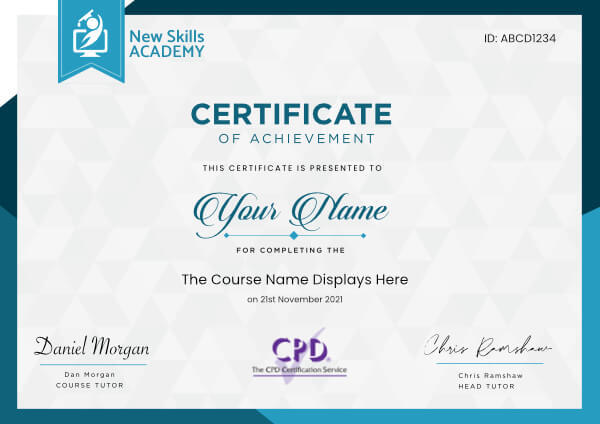
 ID: YDFT67YHJ
of achievement
This certificate is presented to
Your Name

For completing the
Coding for Beginners Certificate
on 21st November 2026
Selena Hurford
Selena Hurford
Course Tutor

Daniel Morgan
Daniel Morgan
Head of Academy
Anyone who has an interest in learning more about this subject matter is encouraged to take the course. There are no entry requirements to take the course.
The course is broken down into 10 individual modules. Each module takes between 20 and 90 minutes on average to study. Although you are free to spend as much or as little time as you feel necessary on each module, simply log in and out of the course at your convenience.
You can study the course any time you like. Simply log in and out of the web based course as often as you require. The course is compatible with all computers, tablet devices and smart phones so you can even study while on the move!
Once you have completed all 10 modules there is a multiple choice test. The questions will be on a range of topics found within the 10 modules. The test, like the course, is online and can be taken a time and location of your choosing.
The pass mark for the test is 70%.
If you don’t pass the test first time you will get further opportunities to take the test again after extra study. There are no limits to the number of times you can take the test. All test retakes are included within the price of the course.
You can either use your Visa, MasterCard, American Express, Solo cards or PayPal account to pay for the online course. Our site uses the latest SSL encryption to ensure your safety. All payments are handled securely by PayPal.
You can begin the course immediately after your payment has been received. You will create your login details during the checkout process. We will also send you an email confirming your login details.
We estimate that the course will take about 11 hours to complete in total, plus an additional 30 minutes for the end of course test.
Once you have been awarded your certificate it is valid for life. The certificate does not expire or need renewing.
This is a fantastic course, it is incredible value for money and it will give you all the information you need to be able to pursue the career of Teaching Assistant.
Being able to do it all in your own time makes it a lot less stressful if you're trying to fit it around work and life in general and the addition of worksheets throughout helps you see which areas need improvement before you take the final test.

Jack Whitcher
I can only say that I enjoyed doing this course and highly recommend it to everybody. It’s very easy to use the website and you can access all the information you need to learn. I’m feeling confident with my career change choice.
I found this way of learning perfect for me, as I could study at my own pace in the comfort of my home plus a great teaching layout for each module. Clear and easy to follow studying method of the 21 modules. This course is very well written and understandable. There is a lot of important information, all the chapters are well proportioned and enjoyable to read and understand and doesn’t take too much time.
I really enjoyed learning about new things of every each modules which give me chance to summarise all the important parts in each module. I can recommend this course to anyone who would be interested in admin and PA.

Elena Cramp
John Grover
A clear and concise course that allowed me to go at my own pace, with no time limit. A great way to learn and study from home so that you can fit it around your daily lifestyle.
With demonstration videos and help always on hand, the course is easy to follow and understand. The course taught me a variety of techniques and methods to apply Make-Up and has also given me the advice and guidance I needed to go forward with a career.
The end test is challenging so it is important to study and revise all modules in order to pass.

Summer Wearn
I think the Admin and PA Diploma course is absolutely terrific. It gives candidates the chance to develop their skills in the PA and Administration field along with gaining some valuable personal skills along the way. It has given me the boost that I needed to be considered for different job roles in the Administration field and without this my CV would not look as good to potential employers. Giving people the chance to succeed at something they really want to be a part of makes this course brilliant in every way. The layout of each module is set out superbly !
Ashliegh Bell
Great course worth the money very detailed yet easy to understand and all official with a certificate at the end it's very interesting and fun

Cherish King
If you are curious about how software works or would like to write your own programs but do not know where to begin, this course is for you. Coding can help you develop practical technical skills, strengthen your problem-solving abilities and better understand the technology used in everyday life.
This introductory course may be useful if you are considering further study, exploring a career in technology or simply looking to improve your digital confidence. You do not need any previous programming experience.
Coding for Beginners Certificate Course
This course introduces the essential concepts needed to begin writing simple programs. It has been designed for beginners and includes practical examples using Python, a widely used general-purpose programming language.
You will progress from basic computing and programming concepts to variables, collections, decisions, loops, functions, modules and object-oriented programming. You will also learn how to handle errors, work with external files and JSON data, and manage third-party packages in a virtual environment.
By the end of the course, you should have a foundation for continued study and be able to plan, write, test and improve small Python programs.
What you will learn:
The course combines explanations, example programs and practical activities to help you apply what you learn. Topics include:
- Important developments in the history of computing and programming
- How computers represent and process information using binary
- How to create variables and use common Python data types and operators
- How to work with strings, lists, tuples, sets and dictionaries
- How to control program execution using conditions and loops
- How to define functions, pass arguments and return values
- How to organise and reuse code with modules and packages
- The principles of object-oriented programming, including classes, objects and methods
- How inheritance and composition can be used to organise related behaviour
- How to handle expected exceptions and respond to errors appropriately
- How to read and write text files and structured JSON data
- How to create virtual environments and install third-party packages safely
Benefits of this course
By completing this course, you will:
- Build a clear foundation in computational thinking and core programming concepts
- Gain practical experience writing, running, testing and debugging Python programs
- Learn how to break problems into smaller, manageable programming tasks
- Understand how to select suitable data types, collections and control structures
- Develop reusable code using functions, modules, packages and classes
- Learn how to handle errors and work safely with text files and JSON data
- Gain experience managing project dependencies with virtual environments and pip
- Complete practical activities that reinforce each stage of your learning
- Develop the confidence to create and improve your own small Python projects
- Establish a strong foundation for further study in programming, automation, data analysis or software development
This course includes
24/7 Student Support
End of course certification
Lifetime access to your course
ID: YDFT67YHJ
of achievement
This certificate is presented to
Your Name
For completing the
Coding for Beginners Certificate
on 21st November 2026
Selena Hurford
Selena Hurford
Course Tutor
Daniel Morgan
Daniel Morgan
Head of Academy
Anyone who has an interest in learning more about this subject matter is encouraged to take the course. There are no entry requirements to take the course.
The course is broken down into 10 individual modules. Each module takes between 20 and 90 minutes on average to study. Although you are free to spend as much or as little time as you feel necessary on each module, simply log in and out of the course at your convenience.
You can study the course any time you like. Simply log in and out of the web based course as often as you require. The course is compatible with all computers, tablet devices and smart phones so you can even study while on the move!
Once you have completed all 10 modules there is a multiple choice test. The questions will be on a range of topics found within the 10 modules. The test, like the course, is online and can be taken a time and location of your choosing.
The pass mark for the test is 70%.
If you don’t pass the test first time you will get further opportunities to take the test again after extra study. There are no limits to the number of times you can take the test. All test retakes are included within the price of the course.
You can either use your Visa, MasterCard, American Express, Solo cards or PayPal account to pay for the online course. Our site uses the latest SSL encryption to ensure your safety. All payments are handled securely by PayPal.
You can begin the course immediately after your payment has been received. You will create your login details during the checkout process. We will also send you an email confirming your login details.
We estimate that the course will take about 11 hours to complete in total, plus an additional 30 minutes for the end of course test.
Once you have been awarded your certificate it is valid for life. The certificate does not expire or need renewing.
This is a fantastic course, it is incredible value for money and it will give you all the information you need to be able to pursue the career of Teaching Assistant.
Being able to do it all in your own time makes it a lot less stressful if you're trying to fit it around work and life in general and the addition of worksheets throughout helps you see which areas need improvement before you take the final test.
Jack Whitcher
I can only say that I enjoyed doing this course and highly recommend it to everybody. It’s very easy to use the website and you can access all the information you need to learn. I’m feeling confident with my career change choice.
I found this way of learning perfect for me, as I could study at my own pace in the comfort of my home plus a great teaching layout for each module. Clear and easy to follow studying method of the 21 modules. This course is very well written and understandable. There is a lot of important information, all the chapters are well proportioned and enjoyable to read and understand and doesn’t take too much time.
I really enjoyed learning about new things of every each modules which give me chance to summarise all the important parts in each module. I can recommend this course to anyone who would be interested in admin and PA.
Elena Cramp
John Grover
A clear and concise course that allowed me to go at my own pace, with no time limit. A great way to learn and study from home so that you can fit it around your daily lifestyle.
With demonstration videos and help always on hand, the course is easy to follow and understand. The course taught me a variety of techniques and methods to apply Make-Up and has also given me the advice and guidance I needed to go forward with a career.
The end test is challenging so it is important to study and revise all modules in order to pass.
Summer Wearn
I think the Admin and PA Diploma course is absolutely terrific. It gives candidates the chance to develop their skills in the PA and Administration field along with gaining some valuable personal skills along the way. It has given me the boost that I needed to be considered for different job roles in the Administration field and without this my CV would not look as good to potential employers. Giving people the chance to succeed at something they really want to be a part of makes this course brilliant in every way. The layout of each module is set out superbly !
Ashliegh Bell
Great course worth the money very detailed yet easy to understand and all official with a certificate at the end it's very interesting and fun
Cherish King
Why you should study with us
Learn with confidence...

 RRP
€100
RRP
€100
Get a FREE Course
Tick this box to Sign up for our newsletter, and get access to the Interview Skills and CV Writing Certificate course for free! By signing up, you agree to our Privacy Notice & Cookie Policy and to receive marketing and related emails from academy+ brands. You can unsubscribe at any time.What our students say about us...

Excellent course, well explained and easy to understand. The course can be done at my own pace and is available on various devices. The layout of the course was excellent and the notes options is very good. The content is perfect and well structured, making it easy to understand and follow. I will definitely be taking more courses in the future.
Luis Costa

The course was clearly set out with helpful end of week tests which built my knowledge. Being dyslexic I found the course was set out in an easy to understand way. I was able to pass the test on my first attempt. The downloaded pdf are a useful resource that you can keep forever. Looking forward to the next course
Ross Dunsten

Very interesting and helpful course. I ve learned a lot of interesting things about make up and the tutorials were very helpful and easy to understand. I really reccomend this course for everyone who is passionate about make up and wish to develop their skills and make a career from their hobby.
Nicoleta Lucaci

Omg im so excited, over joyed and all the good stuff that comes to mind! Wonderful experience doing lessons with New Skills Academy. I look foward to doing more courses with them. I hope this will encourage others to come on board and refresh your minds or to learn something new, it's a win win situation. I want to thank New Skills Academy so much for making this as simple as possible for me.
Shari Anderson

Wow what an incredible insight for the start of anyone's journey in property. This course gives you so much information and there are tests and questions on each of the modules. The course is very easy to follow and well laid out. You can actually make notes on the pages of each module using the notes tab! I am very excited to say that I passed and I only spent one week on this course. I will print all the PDF information and keep it in a file with my certificate. I feel very confident for my future plans now I have completed this course.
Nichola Anderson
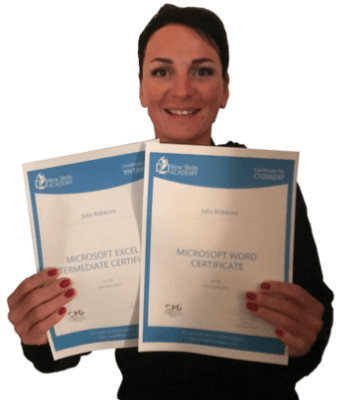
This is a great course for any level of knowledge. Very easy to navigate, great practical tasks and explanations are very clear. You can revise any module with no problem. The test wasn’t too hard if you completed every module. It may be handy to make some notes before you start. Overall I'm very happy with my choice. Thank you New skills for my New skills :)
Julia Bobkova

I took up this course initially to help me with my own dog, but found that as I worked through the material I actually started thinking that this could be something that I could use to make a second income. From start to finish I found the course engaging and interesting. I am now doing another dog related course and am experiencing the same level of enjoyment. I would recommend New Skills Academy without hesitation.
Keith Smith
This course is a great way to brush up on my rusty excel skills, I recommend this course to anyone looking for something to do during lockdown, it's easy to use and talks you through each stage step by step. It has given me the confidence I need to further my career.
Georgia Darke